THE QUICK TAKE
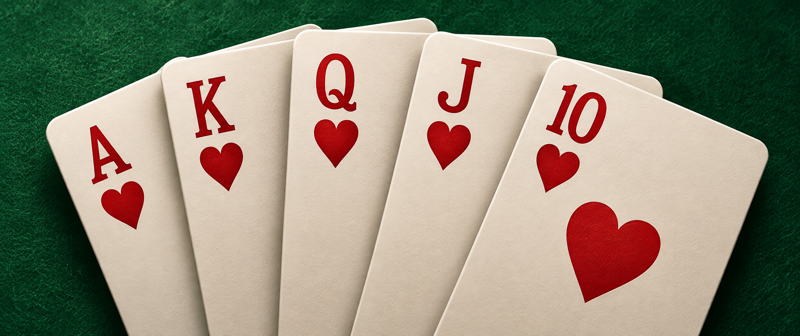
No. J, Q and K have equal point values but different ranks. A set needs matching ranks; J–Q–K can instead be a run when all three cards share one suit.
Traditional Tongits card identification · Original paper worksheet · No move selection
Equal points do not mean equal ranks
No: a jack, a queen and a king are three different ranks. Under the traditional Tongits rules described by Pagat, each is worth ten points, but a set requires three or four cards of the same rank. A run instead requires consecutive ranks in one suit.
Consequently, J♣, Q♦ and K♥ do not form a set. Nor do they form a run, because their suits differ. J♣, Q♣ and K♣ form a run, not a set. The point values alone cannot distinguish those two examples.
Keep three columns on your worksheet
Copy the original sample J♣ · Q♦ · K♥ onto three paper slips. Give each slip its own row in a worksheet:
| Card | Rank label | Suit | Point value |
|---|---|---|---|
| J♣ | Jack | Clubs | 10 |
| Q♦ | Queen | Diamonds | 10 |
| K♥ | King | Hearts | 10 |
Cover the point-value column. The rank labels are still different, and the suit names still differ. Uncover it: the three tens have not changed either observation. This is a reading exercise, not a request to choose cards from a live hand.
If your note only says “10, 10, 10”, you have discarded information needed to identify a meld. Keep the original card labels beside any arithmetic. A calculator can check addition but cannot reconstruct the missing suits and ranks.
Compare three fixed groups
Read each row as a separate demonstration, rather than one combined deal. The same physical card can be reused between demonstrations after clearing the table; it must not be counted twice in a single arrangement.
| Supplied group | Rank check | Classification |
|---|---|---|
| J♣ · Q♦ · K♥ | Three different ranks | Neither set nor run |
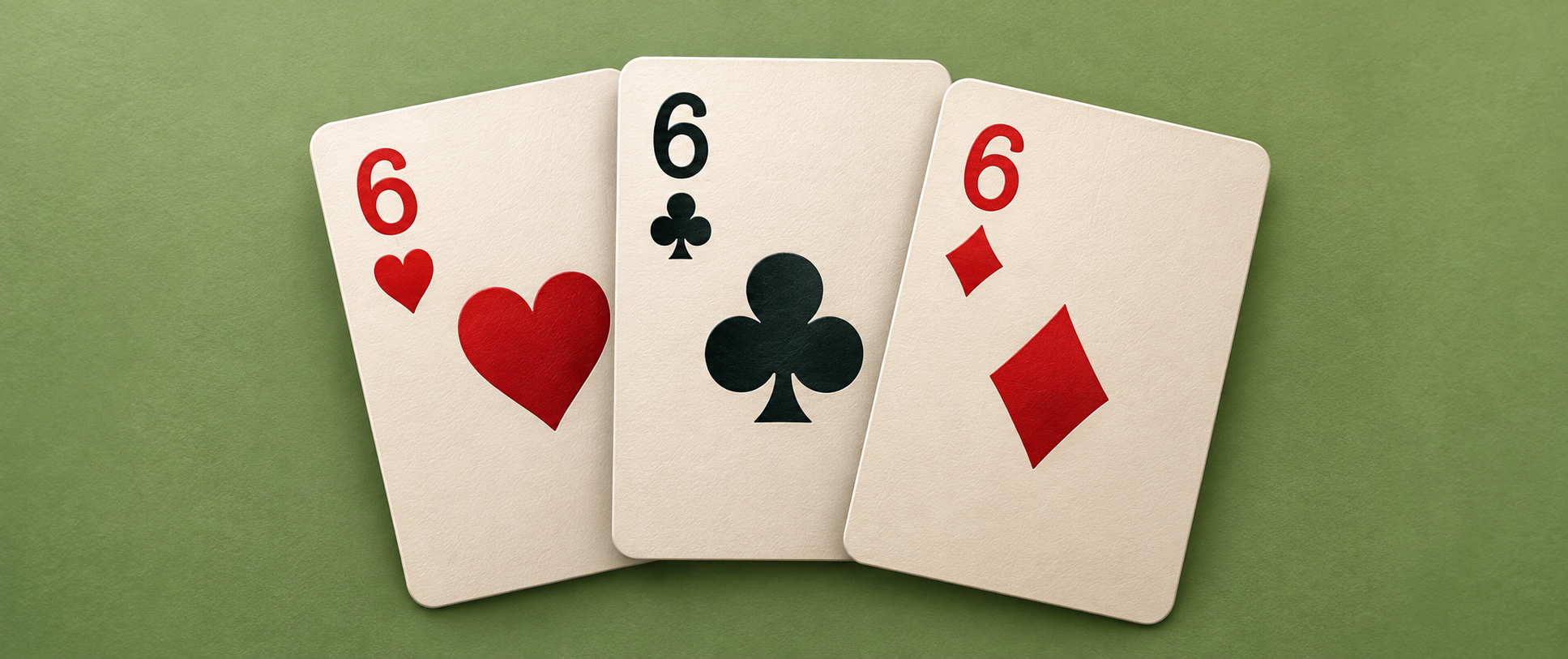
| J♣ · J♦ · J♥ | Three jacks | Set |
| J♣ · Q♣ · K♣ | Consecutive J–Q–K, all clubs | Run |
Every row has three cards, and adding the individual point values produces thirty in every row. Yet the classifications differ. That equal sum is the deliberately unhelpful clue in this exercise: it cannot certify a meld or determine an unmatched total.
Audit a misleading label
CHECK THE REASON
A worksheet shows 10♠ · J♥ · Q♦ and labels it “set: three ten-point cards”. Which part of the explanation is true, and which part fails?
Reveal the explanation
All three cards do have a point value of ten. But their ranks are ten, jack and queen, so they are not a set. They are consecutive ranks in different suits, so they are not a run either. Correct the classification; the point-value entries themselves do not need changing.
Now annotate each card with R for its rank, S for its suit and P for its point value. Underline the column used in the incorrect explanation. A partner can check your reasoning without seeing a full hand or making any playing decision.
Classify first; count separately
The existing points worksheet explains counting already identified unmatched cards. This lesson addresses the earlier question: whether equal numerical values establish a set. They do not. Summing the values of every card shown is not automatically an unmatched-card total.
For visual definitions, use sets, runs and sapaw. For another classification error, see why one card cannot occupy two melds. Each worksheet isolates one issue; none reconstructs a finished game or decides a winner.
This is a no-stakes paper exercise using the cited traditional rules. It makes no claim about an App’s automatic grouping, hints, scoring display or available modes. Check the instructions for the exact mode before interpreting its interface.
Sources & scope
Checked on October 17, 2026. Pagat supplies traditional card values and set/run definitions. The comparison tables, covered-column exercise and misleading-label audit are original. No App mode or automatic grouping feature was tested.
- Pagat — Tong Its ↗Independent reference for traditional card-game rules; not an App-specific rulebook.
This is an independently written educational guide, not an official rulebook or a promise of results. Illustrations are original examples, not screenshots from the game.