THE QUICK TAKE
No. Twelve is the initial deal for each non-dealer in the traditional rules used here. Cards laid down as melds leave the held hand, and the rules do not refill that hand to twelve after melding.
Traditional Tongits card-count vocabulary · Fixed no-stakes record · No move recommendations
Separate the deal from a later hand
Our deal-count guide explains the dealer’s thirteen cards and the other players’ twelve. Those are starting quantities. They are not a rule that every player must keep holding the same number throughout play.
Pagat’s ordinary turn begins with one draw, allows melding and laying off, and ends with one discard. When a player puts a meld on the table, its cards are no longer physically held. The sequence has no extra draw step that replaces each card just laid down. This lesson follows a supplied record; it does not suggest which cards to play.
Read one fixed four-step record
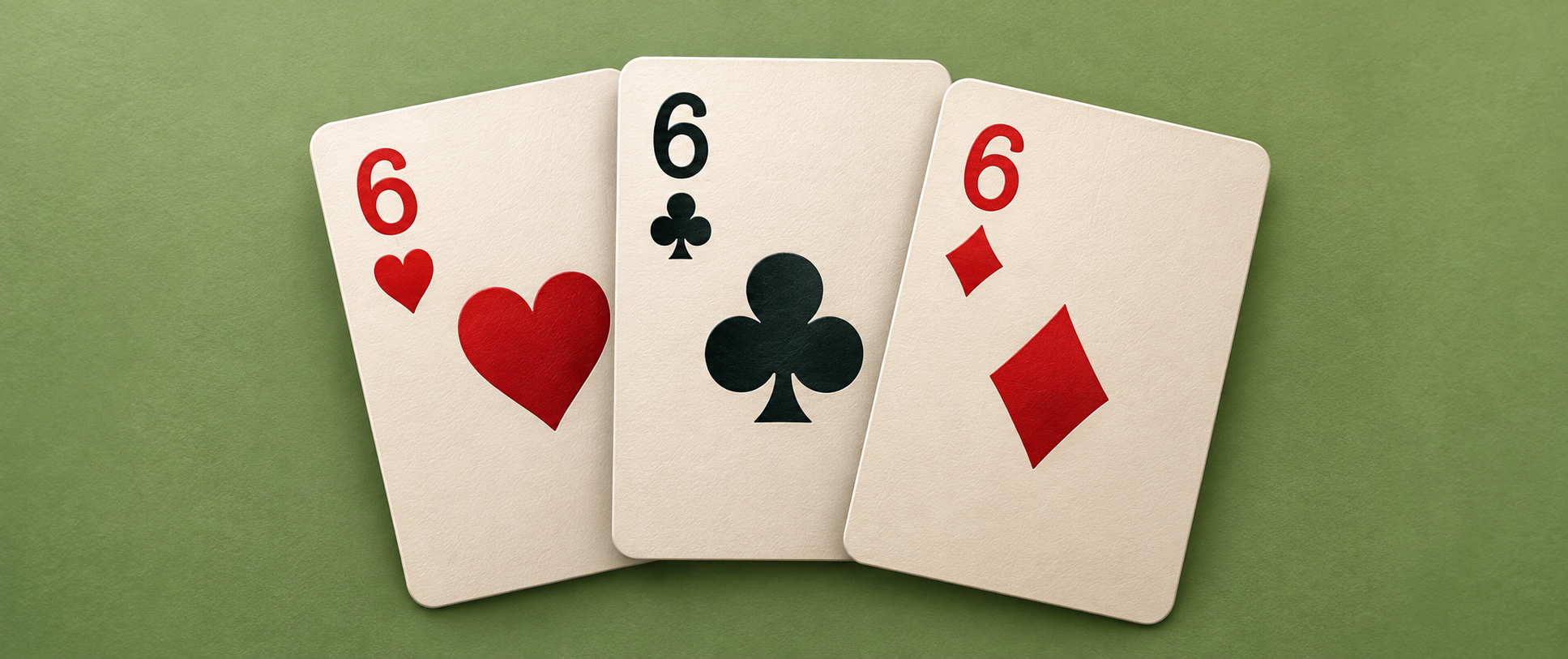
Ana is a non-dealer about to take her first ordinary turn. She holds twelve cards, including the pre-labelled set 8♣ · 8♦ · 8♥. The fictional record states that she draws one stock card, exposes that set, makes no sapaw and discards one other held card. No ending is declared.
| Checkpoint | Change in held cards | Cards held now |
|---|---|---|
| Before her draw | Starting count | 12 |
| After one stock draw | +1 | 13 |
| After exposing the three eights | −3 | 10 |
| After one discard | −1 | 9 |
Read the calculation as 12 + 1 − 3 − 1 = 9. The three eights remain on the table; they have not vanished from the deck. This table counts only Ana’s held cards, not the stock, other hands or every card on the table.
The other card identities are intentionally unspecified because the actions are already supplied. The record is sufficient for this quantity calculation, but not for reconstructing the full deal, judging every card choice or deciding a winner.
Do not add an unrecorded refill
A learner sees nine cards and writes “draw three replacements to return to twelve”. That line adds an action absent from the stated rules and record. Melding reduces the number held; it does not create a refill allowance.
If Ana later begins another ordinary turn still holding those nine cards, one draw takes her to ten at that moment. What she holds after the turn depends on the actions that actually follow. Do not copy nine or twelve into the final column without reading the rest of the log.
Likewise, a decrease of three cards alone does not prove that a set was exposed. A bare counter does not tell you the cards’ destination or whether the log omitted an action. Keep the action words beside the arithmetic.
Find the invented action in a note
CHECK EACH CHANGE
A note copies Ana’s record as 12 → 13 → 10 → 9 → 12. It labels the final arrow “automatic refill after melding”. Which arrow lacks support? Does that error mean the three-card set itself is invalid?
Reveal the explanation
The final 9 → 12 arrow has no support: the ordinary sequence does not grant three replacement draws. The supplied three eights still form a set. An invented refill and an invalid card group are different errors; this note demonstrates the former.
On a clean copy, write one row per recorded action and stop after the discard. As a second arithmetic check, the thirteen cards held immediately after drawing are accounted for by nine still held, three exposed and one discarded: 9 + 3 + 1 = 13. This check concerns only the cards in that snapshot.
Keep quantity and other checks separate
A held-card count is not an unmatched-point total. A valid meld can also remain held, so the number physically in hand does not by itself identify unmatched cards. Use the card-points exercise for that separate distinction.
This example excludes sapaw, discard pickups and special endings to isolate one change. The table-area guide helps distinguish where cards go, while the no-final-discard Tongit lesson covers a separate ending exception. A digital counter may have its own meaning; this paper record does not verify any Tongits Go interface, result or payment rule.
Sources & scope
Checked on October 12, 2026. Pagat supplies the initial deal and ordinary draw, expose and discard sequence. The fictional record, held-card arithmetic and missing-step exercise are original teaching material. App counters and animations were not tested.
- Pagat — Tong Its ↗Independent reference for traditional card-game rules; not an App-specific rulebook.
This is an independently written educational guide, not an official rulebook or a promise of results. Illustrations are original examples, not screenshots from the game.