THE QUICK TAKE
Name both parts: 7 of hearts, not just “a red seven”. A card’s identity and its value under a game’s rules are different questions.
Paper-card literacy for Filipino beginners · Standard French-suited deck · No stakes or App account needed
A card has a rank and a suit
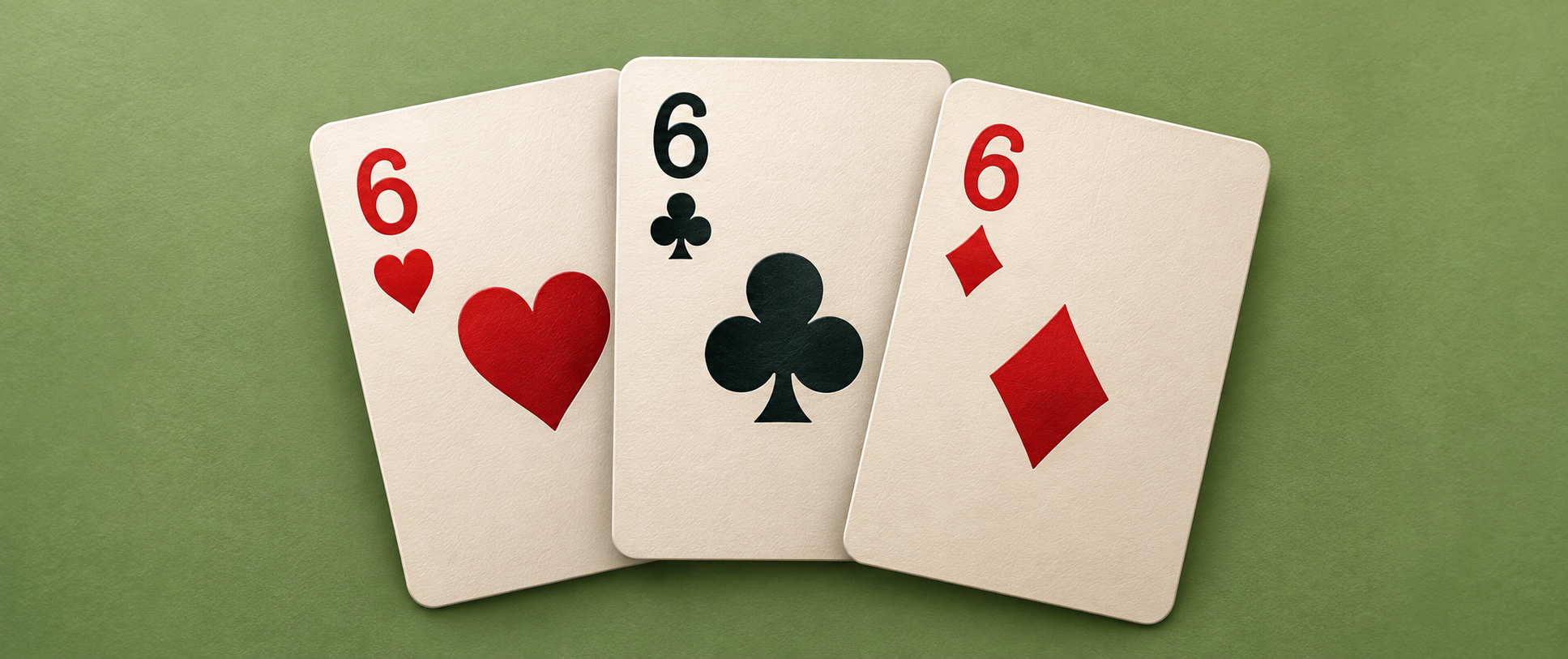
Before reading a Tongits or Pusoy guide, practise saying what is printed on one card. Its number or letter identifies the rank; its symbol identifies the suit. Together they distinguish that card from the others in a standard deck.
For example, 7♥ means seven of hearts. The seven of diamonds shares its rank, while the queen of hearts shares its suit. Neither is the same card.
Try writing two columns headed “rank” and “suit”. Put 7 in the first and hearts in the second. This gives you a precise description to use when a written example looks confusing.
Learn the four symbols
| Symbol | Suit | Read this example |
|---|---|---|
| ♥ | Hearts | 4♥: four of hearts |
| ♦ | Diamonds | 4♦: four of diamonds |
| ♣ | Clubs | 4♣: four of clubs |
| ♠ | Spades | 4♠: four of spades |
On a familiar two-colour deck, hearts and diamonds are red; clubs and spades are black. Match the symbol, not colour alone. Two red cards can belong to different suits. Reading the suit name also keeps the example clear if colours are hard to distinguish.
These rows identify symbols. Their order in this table is not a strongest-to-weakest ranking.
What do A, J, Q and K mean?
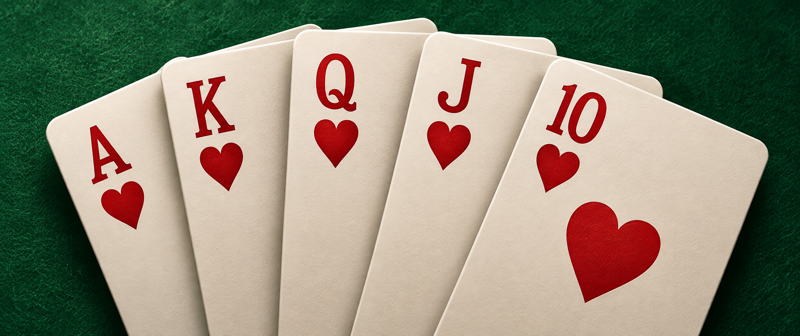
In the usual English-indexed pack, A is ace, J is jack, Q is queen and K is king. Each suit contains these four ranks plus the numbers 2 through 10: thirteen cards per suit, or 4 × 13 = 52.
Jokers are additional cards outside those 52 and do not belong to one of the four suits. Whether they are included, and what they do, depends on the game. A picture of a joker does not automatically make it a substitute for any missing card.
Likewise, recognising an ace does not tell you whether it ranks high or low. Read the rules of the exact game before assigning values. Our Pusoy and Pusoy Dos comparison explains why similar game names should not be treated as interchangeable.
Check a physical deck before practising
Here is a simple no-stakes exercise: separate the cards into four suit piles, then put the thirteen rank labels in a consistent order within each pile. Set any jokers or information cards beside the piles.
Count each pile and look for both missing labels and duplicates. Counting thirteen alone can miss a problem: a pile with two sixes and no seven still contains thirteen cards. Comparing each rank label makes that mismatch visible.
You are checking the materials, not calculating a winning hand. Once the deck is complete, choose any two cards and describe exactly what they share.
Try three quick identification checks
READ, THEN REVEAL
1. Do 8♥ and 8♦ share a rank, a suit, or both?
2. What do 3♣ and K♣ share?
3. Does a joker belong in the hearts pile when checking the standard 52?
Reveal the answers
1. Same rank: both are eights. Different suits.
2. Same suit: both are clubs. Different ranks.
3. No. A joker is separate from the four suits and the standard 52-card count.
If those distinctions feel clear, move on to sets, runs and sapaw. That guide uses rank and suit to explain groups of cards; this exercise only asks you to identify individual cards correctly.
Sources & scope
Checked on September 12, 2026. General card identification and original practice examples. This page does not establish the ranking, scoring or deck used by a particular Tongits Go mode.
- Pagat — French-suited cards and the 52-card pack ↗The four suits, standard pack composition and separate joker cards.
- Pagat — mechanics of card games ↗How a card is identified by its face, suit and rank; general conventions have game-specific exceptions.
This is an independently written educational guide, not an official rulebook or a promise of results. Illustrations are original examples, not screenshots from the game.