THE QUICK TAKE
The top discard must form a new set or run with at least two cards from your hand, and that meld must be exposed. Taking it only for sapaw on a table meld does not meet this condition.
Traditional Tongits rules for adult Filipino beginners · Fixed no-stakes examples · Not move-selection advice
A visible card is not a free pickup
In Pagat’s traditional Tongits rules, a normal turn begins with a stock draw or a permitted top-discard pickup. The latter has a specific condition: use the discard with at least two held cards to make a new meld, then expose that meld. Picking it up only to add it to an existing table meld is not permitted.
Sapaw means adding a fitting card to an existing meld. It is a different action from forming the new meld required here. Our table-area guide identifies the hand, stock, discard pile and exposed groups.
Example A: identify all three cards in the new group
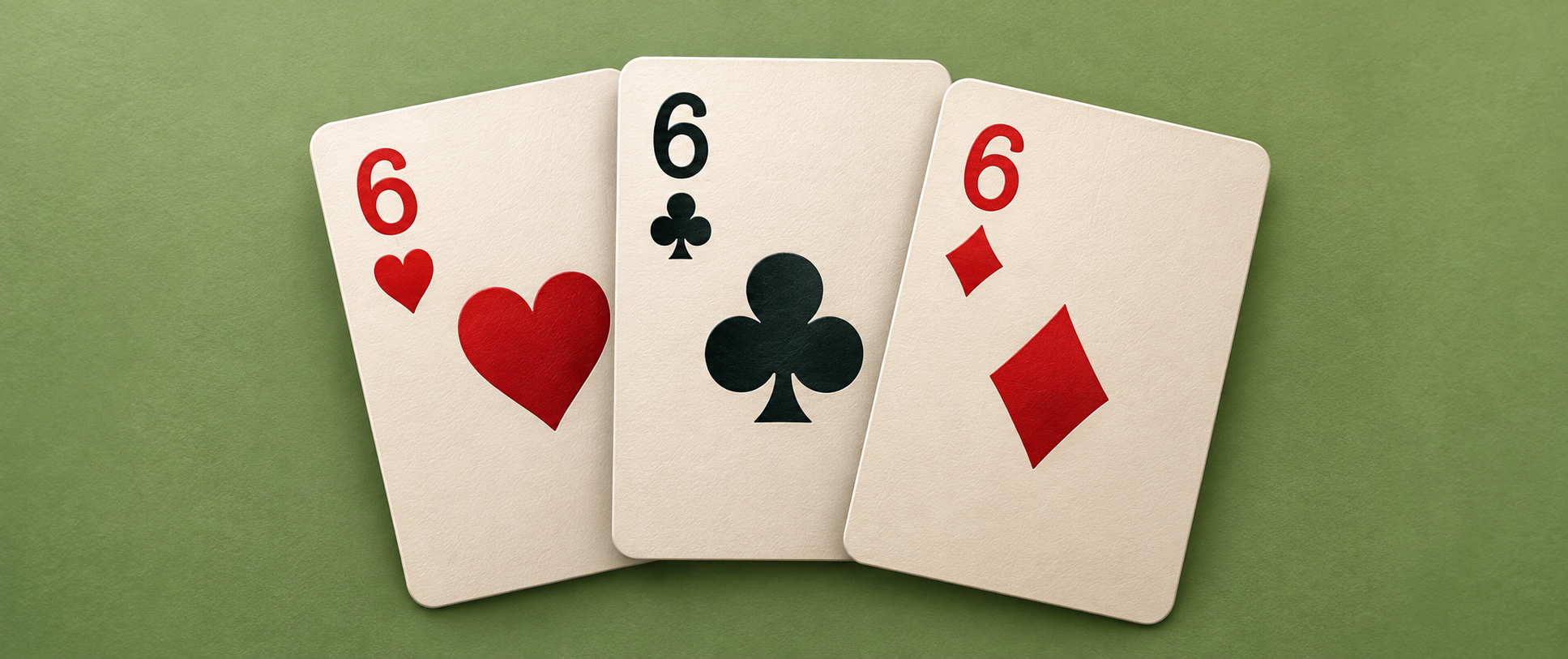
Copy this incomplete teaching snapshot onto paper. The top discard is 8♦. Two cards marked “in hand” are 8♣ and 8♥. Draw an empty box labelled “new exposed meld”.
Write the proposed group inside the box: 8♦ · 8♣ · 8♥. It is a set of three eights, using the discard and two held cards. This proposal meets the pickup condition when that new group is exposed. Merely putting 8♦ into the hand and leaving the proposed group hidden would not complete the required action.
Underline the two held-card labels and circle the discard label. That annotation makes the origin of every card explicit. These three labels are not a complete dealt hand.
Example B: a fitting card, but the wrong action
On a separate sheet, label 5♠ · 6♠ · 7♠ as “already exposed on the table”. The top discard is 8♠. The proposal says only: “Take 8♠ and add it to that table run.”
The card fits the end of the run, but this proposal is sapaw on an existing meld. It supplies no new meld with two held cards, so it does not satisfy the discard-pickup condition. “Fits somewhere” is not the same test as “forms the required new group”.
Do not invent extra held cards to repair the example. Mark only what the proposal actually describes. For the shapes of sets and runs, use our meld vocabulary guide.
Check a proposed pickup in three lines
- Write the exact top-discard label, including its suit.
- List the held cards proposed for the new group, keeping their labels separate from cards already on the table.
- Name the new group and state that it will be exposed.
If the description omits a needed label or only names an existing table group, mark the missing information. This worksheet helps you explain a rule check; it does not compare possible moves or recommend which card to take.
Self-check: the missing middle card
CHECK THE STATED PROPOSAL
The top discard is 6♥. The proposal uses held 5♥ and 7♥, then exposes 5♥ · 6♥ · 7♥ as a new group. Does it meet the pickup condition? Would leaving that group hidden also meet it?
Reveal the explanation
The exposed proposal meets the condition: the three consecutive hearts form a new run, using the discard and two held cards. Leaving that group hidden would omit the required exposure. The check is limited to these stated cards and this action.
Read the full beginner turn sequence for the surrounding steps and the dealer’s opening exception. Digital controls, automatic grouping and mode variations need their own help text; no App interaction was tested for this lesson.
Sources & scope
Checked on September 24, 2026. The pickup condition is from Pagat’s Tong Its play rules. The labelled examples and checking worksheet are original. They test this one condition, not a complete turn, outcome or Tongits Go mode.
- Pagat — Tong Its ↗Independent reference for traditional card-game rules; not an App-specific rulebook.
This is an independently written educational guide, not an official rulebook or a promise of results. Illustrations are original examples, not screenshots from the game.